News
The Algorithm Alchemist: Tejs Vegge Aims to Shave Years Off the Green Transition
Published online: 20.02.2026
News
The Algorithm Alchemist: Tejs Vegge Aims to Shave Years Off the Green Transition
Published online: 20.02.2026
The Algorithm Alchemist: Tejs Vegge Aims to Shave Years Off the Green Transition
News
Published online: 20.02.2026
News
Published online: 20.02.2026
By Thomas Møller Christensen, AAU Communication and Public Affairs
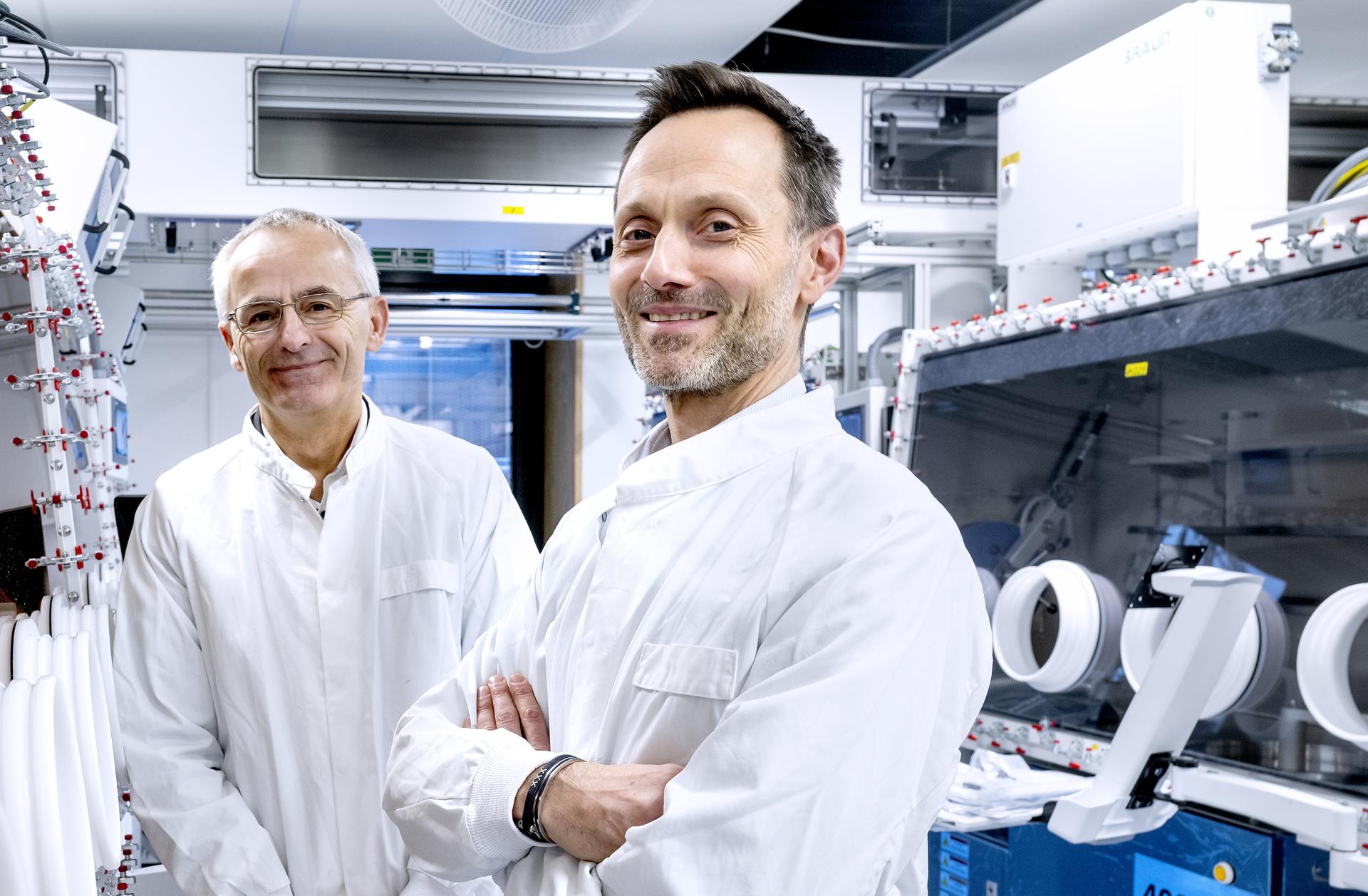
Photo: Bax Lindhardt
It is a frustration familiar to both boardrooms and laboratories: developing a new advanced energy material typically takes 10 to 20 years, whether it is a catalyst needed to make Power-to-X economically viable or a sustainable battery material capable of powering heavy-duty transportation. But in a world demanding immediate climate action, two decades is an eternity.
This is where Tejs Vegge enters the picture. Alongside Professor Frede Blaabjerg from AAU Energy, he leads the Pioneer Center for Accelerating P2X Materials Discovery (CAPeX). He is not searching for a single wonder material – he is building a method capable of discovering many new materials and doing so dramatically faster.
Where alchemists once dreamed of turning lead into gold, Tejs Vegge deploys algorithms and artificial intelligence to systematically uncover new energy solutions hidden in vast datasets.
"By letting artificial intelligence and robots take over the laboratory, we're trying to make the process five to ten times faster. At the same time, advanced machine learning algorithms can reduce the number of necessary physical measurements by a factor of ten or more," says Tejs Vegge.
CAPeX was established in 2023 through broad collaboration between DTU, AAU and a network of other national and international universities, supported by five Danish foundations.
The Pioneer Center functions as an international scientific green dream team, bringing together experts and expertise across the entire value chain – from molecular insight to full system integration.
"We're building scientific LEGO bricks and a 'digital twin' that spans from the atomic scale to gigawatt-scale energy islands. Our goal is to be able to change the atomic structure or composition of energy materials and immediately see the consequences for the stability and efficiency of the entire energy system," explains Tejs Vegge.
The aim is to design more efficient and sustainable materials for Power-to-X facilities, enabling green electricity from wind farms, solar parks and energy islands to be converted, transported and stored exactly when society needs it, either in form of a sustainable fuel or chemical.
Tejs Vegge is a theoretical materials physicist and professor at DTU Energy. Atoms are his academic foundation, but today he uses that knowledge to lead an environment that combines simulation, machine learning and automated experiments.
Traditionally, materials research has relied on trial and error, with researchers manually testing one hypothesis at a time. For Tejs Vegge, that pace is no longer acceptable.
"The manual and sequential process is one of the biggest obstacles to the green transition. That's why at CAPeX we've replaced some of our manual experiments with autonomous laboratories. Here, we use AI and machine learning to search millions of atomic combinations digitally, after which robots physically test the most promising candidates around the clock," he says.
The results feed directly back into the AI model, which the learns with each iteration. A synthesis process for nano particles that normally takes six months can now be completed in a few hours. This often raises questions about the researcher's role in an automated world.
"We're not leaving it entirely to AI. We have researchers to analyse and guide the process with their expert knowledge. It's like playing seven against six in handball – the AI algorithm takes on the heavy experimental work, giving the researcher a free role to apply their creativity where it's needed most," the professor points out.
Speed, however, is only half the equation. For industry, scalability and supply security are crucial. CAPeX researchers are therefore searching for alternatives to critical and costly raw materials such as lithium, cobalt and iridium.
"The materials need to be made from elements we have available in Europe and can produced cheaply at scale. Otherwise, it'll never be competitive," emphasises Tejs Vegge.
That focus pushes the research beyond the laboratory and into corporate strategy rooms. By designing materials from the outset to withstand industrial production and operational conditions, CAPeX aims to reduces the technical risk for companies investing in tomorrow's infrastructure.
"It's about finding solutions that last long enough to actually make commercial sense for industry to invest in them," he explains.
Though Tejs Vegge’s daily work revolves around invisible atoms, the ambition is anything but small: enabling the production of tomorrow’s green fuels, chemicals and batteries capable of operating at gigawatt scale. It is one of the reasons he has been chosen as keynote speaker for AAU Energy's Research Day, fittingly titled “From Molecules to Megapower”.
There, he will outline how AI-driven laboratories are closing the gap between fundamental science and industrial deployment.
"I hope the audience leaves with an appreciation of just how big a challenge we're facing. But I also want to show them how we at CAPeX are using artificial intelligence to deliver the necessary answers," says Tejs Vegge, before issuing a final challenge:
"We need to move away from the old mindset and realise that acceleration is key. We must compress decades of development into months to deliver the answers the green transition requires.”
Time remains the climate crisis's most unforgiving constraint. But with the right algorithms and a laboratory that never sleeps, Tejs Vegge hopes to turn it into a variable we can work with, rather than against.
Facts about CAPeX
CAPeX, the Pioneer Center for Accelerating P2X Materials Discovery, is a research center focused on reinventing how sustainable Power‑to‑X materials are discovered. It brings together leading scientists, advanced digital tools, and automated laboratory systems to speed up the development of next‑generation P2X materials.
CAPeX integrates computational design, operando characterization, scalable synthesis, robotics, digital twins, and machine learning into a unified, self‑driving discovery platform capable of rapidly identifying, testing, and validating new materials.
What makes CAPeX unique:
CAPeX is a joint initiative between DTU and Aalborg University, involving researchers from five Danish universities and three international partners.
Established in May 2023, the centre is funded for 13 years by the Danish National Research Foundation together with the Novo Nordisk Foundation, Carlsberg Foundation, Villum Foundation, Lundbeck Foundation, and the Ministry of Higher Education and Science.

On 28 April 2026, Aalborg University will become the meeting point for leading minds in the global energy transition when AAU Energy hosts the one-day event “From Molecules to Megapower.”