News
Major grants back AAU’s battery aging research

News
Major grants back AAU’s battery aging research
Major grants back AAU’s battery aging research
News
News
By Catharina Slot Pihl and Niels Landbo Krogh, AAU Communication & Public Affairs
Photo: Farshid Naseri
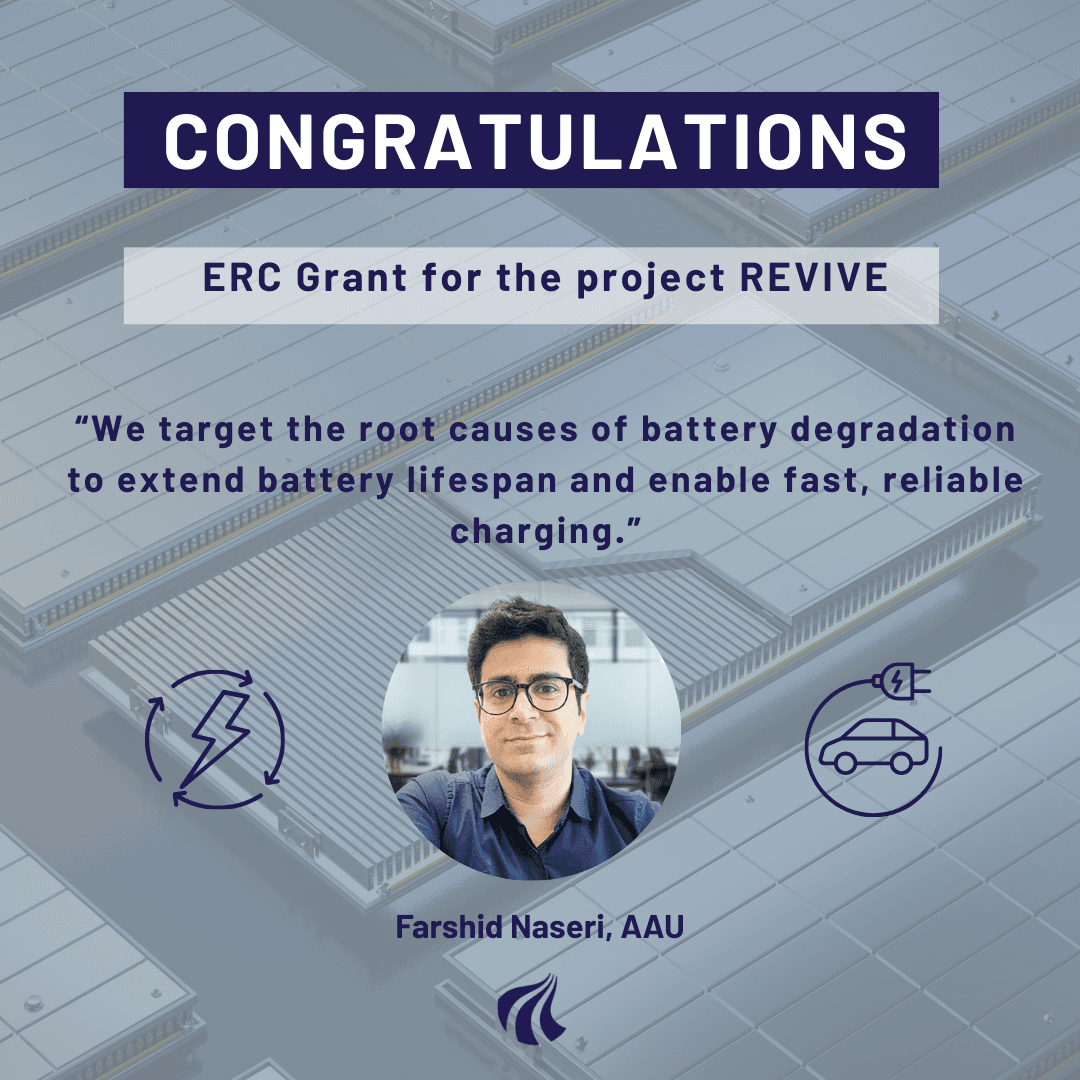
The project, titled REVIVE, "Rejuvenation and Anti-Aging Mechanisms for Vitalizing Next-Generation Electric Vehicle Batteries", aims to tackle one of the biggest challenges in the transition to electric mobility: Battery degradation. While EV drivetrains and electronics can last over 20 years, batteries often degrade to 70% capacity within just 8-12 years – forcing costly replacements and raising environmental concerns.
REVIVE takes a deep dive into the root causes of battery aging, focusing on electrode-level monitoring and refurbishment techniques that could extend battery life and reduce environmental impact. Instead of relying solely on external systems like cooling or battery management software, REVIVE rethinks battery aging from within – at the material level – where degradation begins.
To understand how close we are to EV batteries that can truly match the lifetime of the vehicle – and how REVIVE could help make that a reality – we spoke with Farshid Naseri:
How far are we from having EV batteries that last as long as the car itself – is it something we could see within the next decade?
"EV battery technology has come a long way. Average degradation has improved from about 2.5% per year in 2019 to 2% per year in 2024. Under normal usage conditions, this puts EV batteries on track to last the life of the vehicle.
But in harsher real-world conditions – like frequent fast charging or extreme climates – the wear can be more pronounced, and the life gap will still be there. Emerging battery chemistries and next-generation designs promise longer life, but these technologies are still not mature, and market readiness will not be good for the next 5-10 years.
Meanwhile, the sheer scale of batteries reaching their retirement period poses a challenge. That's why REVIVE's ambition is to refurbish EV batteries – to squeeze every drop of value from these resources."
Do you imagine REVIVE’s tools being something car manufacturers could integrate into existing EV platforms – or would it require a redesign of battery architecture or vehicle systems?
"The tools we are exploring could follow a few different pathways depending on the outcomes. For instance, some treatments might be introduced at the charging station level, requiring very little change to the vehicle or battery itself. Others might be more suitable for application during a workshop service.
And yes, there is also a possibility that certain techniques could be integrated directly into future EV platforms. We are inviting different stakeholders to our advisory board to ensure scalability for each of the techniques."
Is there a possibility that refurbished batteries could become a certified alternative to buying new ones – and how might that affect the EV market?
"Yes, that possibility is very real.
If refurbishment processes can be standardized and certified, refurbished batteries could offer a trusted and lower-cost alternative to buying new packs.
For the market, it could open a second-hand supply chain of EV batteries – much like we already see with engines and other car components. It would also ease demand pressures on critical raw materials and strengthen sustainability in the industry.
Personally, I think it could become a key lever not only for affordability, but also for consumer confidence – knowing there’s a certified, reliable option beyond a brand-new battery."
Additional support for battery research
Besides his ERC-support Farshid Naseri has also received funding from Villum Foundation, one of Denmark’s largest private foundations supporting technical and natural sciences.